
The LAZR-DCOM Advantage: Why Our Results Are Different
- Jun 29
- 4 min read
Why "Just Stretching" Your Spine Doesn't Fix a Herniated Disc
One Tool Is Rarely Enough
If you have a severely herniated disc, you've probably already tried the usual menu: someone "cracks" your back, or a table "stretches" your spine, or a therapist hands you a sheet of exercises. You feel better for a day — and then you're right back where you started.
That's not because those tools don't work. It's because, used alone, they're only doing half the job. A herniated disc surrounded by inflamed, "sticky," guarded tissue resists change. You can pull on it all day, but if the surrounding tissue won't release, the disc won't move the way it needs to.
That's exactly the problem we built the LaZR-DCoM protocol to solve — and it's why our results often differ from decompression or therapy alone.
How It Works: The 1-2 Punch
LaZR-DCoM combines two technologies in a deliberate sequence, so each one makes the other more effective.
Step 1 — The Laser (LaZR). We start with high-intensity Class IV laser therapy to "pre-treat" the area. The laser increases blood flow, reduces sticky inflammation, and softens the ligaments and tissue around the disc. Think of it like warming a piece of cold clay before you try to shape it — cold clay cracks, warm clay molds.
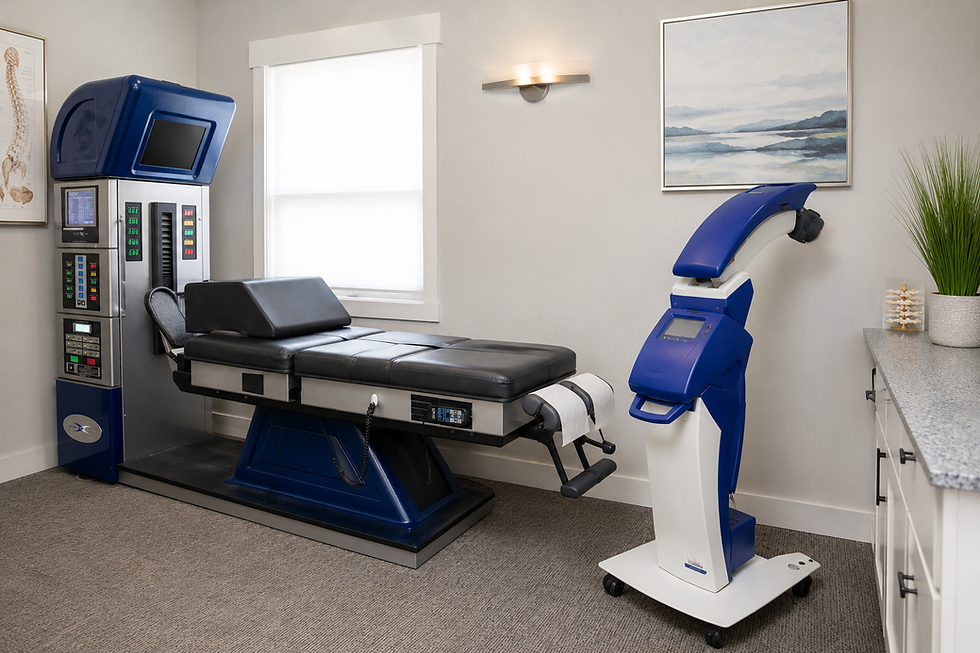
Step 2 — The Decompression (DCoM). Once the tissue is prepped, our computerized decompression table creates a precise, controlled negative pressure — a gentle "vacuum effect" at the exact spinal level we're targeting. Because the laser already reduced the inflammation, the disc can retract and rehydrate more easily and efficiently than decompression could achieve on its own.
Decompression alone | LaZR-DCoM (laser + decompression) | |
Tissue prep | None | Laser softens tissue & cuts inflammation first |
Disc response | Fights against guarded, inflamed tissue | Retracts more easily into prepped tissue |
Scar tissue | Largely unaddressed | Laser helps break down old scar tissue |
Goal | Stretch the spine | Remodel the segment |

The "Before and After" Difference
When we compare imaging from patients who completed LaZR-DCoM against more traditional approaches, two changes stand out:
Disc height restoration: A measurable increase in the millimeters of space between vertebrae — the cushion coming back.
Scar tissue reduction: The laser helps break down the "junk" tissue that causes chronic stiffness long after an old injury.
You can see real patient before-and-after imaging here. These are the structural changes behind the 92% success rate we've documented across complex spine cases — and they're why so many patients who'd "tried everything" finally get traction with this protocol.

Are You a Candidate?
Here's something most clinics won't tell you: we don't accept every case for LaZR-DCoM.
This protocol works by remodeling spinal segments that are still capable of change. Your MRI is our roadmap — it tells us whether your discs can still be rehydrated and your spine restored, or whether the degeneration is too advanced for this approach to help. We'd rather tell you the truth up front than enroll you in care that won't deliver.
If you have your discs on a CD or a written report, bring them in. Let's look at your "before" together and determine, honestly, whether we can build you a meaningful "after."
Frequently Asked Questions
Q: Is LaZR-DCoM painful? No. Most patients find both the laser and the decompression comfortable — many relax or even fall asleep during sessions. The goal is gentle, controlled change, not force.
Q: How is this different from regular spinal decompression? Standard decompression stretches the spine. LaZR-DCoM prepares the tissue with Class IV laser first, so the decompression phase is more effective at retracting the disc and addressing the surrounding inflammation and scar tissue.
Q: How long until I see results? It varies by case and severity. Many patients feel symptom relief well before their imaging fully reflects the change — disc height restoration shows up later as confirmation. We'll give you realistic timelines after reviewing your scans.
Q: Will this work for me? Maybe — and we'll be honest about it. Candidacy depends on what your imaging shows. If your spine can still be remodeled, you're likely a good fit. If not, we'll tell you and point you toward better options.
Q: Do I need surgery instead? Many patients explore non-surgical options like this specifically to avoid surgery. Whether that's realistic for you depends on your individual case, which is what the consultation and imaging review determine.
See the "Before." Plan the "After."
A severe disc injury usually needs more than a single tool. LaZR-DCoM was designed as a coordinated, two-step approach for exactly the complex cases that don't respond to stretching or adjustments alone — and we use your imaging to make sure it's the right fit before you commit.
Bring your scans and let's find out together.
Your first visit includes:
A review of your MRI or X-ray imaging in plain English
A full spinal assessment and candidacy evaluation for LaZR-DCoM
An honest opinion on whether your spine can be remodeled
A personalized treatment plan with clear expectations
📞 Call (801) 302-0280 to schedule. 🗓️ Book online — most new patients are seen within 48 hours.
Elite Performance Health Center — 10434 S. 4000 W., South Jordan, UT 84009 — (801) 302-0280
This article is for general education and is not medical advice. Individual results vary; candidacy is determined by clinical evaluation and imaging.
Comments